
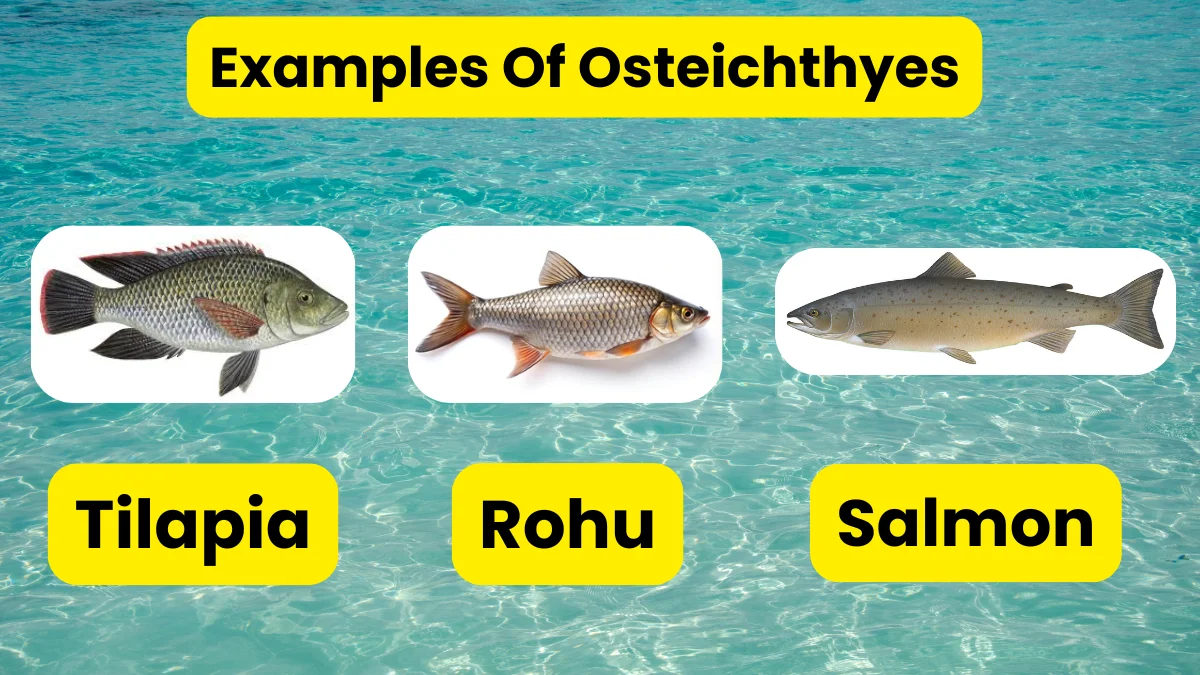
Rohu, goldfish, salmon, tuna, catfish, trout, bass, common carp, herring, cod, seahorses, lungfish, angelfish, betta, and trout are some common examples of Osteichthyes (Bony fishes).
Osteichthyes is a class of jawed fishes with a bony endoskeleton. Osteichthyes is the largest class of vertebrates on Earth. This group includes a variety of marine and freshwater bony fishes. The other group of jawed fishes are cartilaginous fishes, placed in the class Chondrichthyes.
With over 29,000 species and more than 400 families, Osteichthyes is the largest class of vertebrates today.
Examples of Osteichthyes
Bony fishes have a remarkable variety of forms and adaptations. They live in every type of aquatic environment. These fishes are found in freshwater rivers and lakes. They inhabit all ocean zones, from shallow reefs to deep-sea trenches. Here are 20 examples of bony fishes across marine, freshwater, and aquarium environments.
Marine Bony Fishes
Here are some examples of marine bony fishes:
1. Hippocampus (Sea horse)
Males of sea horses carry eggs in a special brood pouch until they hatch. These are the only fish species where males undergo pregnancy. Their upright posture and prehensile (hook-like) tail help them grasp seagrass and corals.
2. Exocetus (Flying fish)
Exocetus (Flying fish) can glide above the water surface to escape predators. These fish use their enlarged pectoral fins as wings. Some flights can cover distances over 200 meters.
3. Lophius (Angler fish)
Angler fish uses a fleshy lure (fishing trape) on its head to attract prey in deep waters. This lure contains bioluminescent bacteria that produce light. Females are much larger than males, and males sometimes attach to females as parasites.
4. Ocean sunfish (Mola mola)
Ocean sunfish is the heaviest bony fish, weighing over 900 kilograms. This fish can produce up to 300 million eggs at once, more than any other vertebrate. They often float near the surface to be cleaned by seabirds.
5. Marlins and swordfish (family Istiophoridae)
Marlins and swordfish can reach lengths up to 4.5 meters. Their upper jaw forms a long spear (knife-like structure) used to tear and stun prey. These fishes are among the fastest fish in the ocean.
6. Tuna
Tuna are commercially important fish that show some ability to warm their bodies. Tuna can maintain muscle temperatures above surrounding water, that makes them powerful swimmers. Some species can swim at speeds up to 75 kilometers per hour.
7. Opah
Opah is a warm-blooded bony fish that circulates heated blood throughout its body. Its specialized blood vessels in the gills trap heat. This allows it to maintain an active lifestyle in cold deep waters.
Freshwater Bony Fishes:
Here are some examples of freshwater bony fishes:
8. Labeo rohita (Rohu)
Rohu is an important food fish common in South Asian rivers. This fish feeds mainly on plants and grows quickly in aquaculture ponds. This is widely cultivated across India and Bangladesh.
9. Labeo catla (Katla)
Katla is a large freshwater fish widely used in aquaculture. This fish has a distinctive upturned mouth adapted for surface feeding. It can grow over 1 meter in length.
10. Clarias (Walking catfish or Magur)
This fish can move across land using its fins. It has an accessory breathing organ that allows it to survive in low-oxygen water. During rains, it migrates overland to find new ponds.
11. Mystus (Catfish)
Mystus are common river fish with distinct whisker-like barbels. The barbels help them locate food in muddy waters. These are popular as both food and aquarium fish.
12. Arapaima gigas
This fish is among the largest freshwater fish, found in the Amazon. It can reach lengths over 3 meters and weigh up to 200 kilograms. It must go to the surface regularly to breathe air because its gills are reduced.
13. Beluga sturgeon
This species is the largest freshwater bony fish. It can grow over 5 meters long and live for over 100 years. Its eggs are processed into expensive caviar.
14. Paedocypris progenetica
This fish is the smallest known vertebrate, measuring under 8 millimeters. It lives in acidic peat swamps in Southeast Asia. Its tiny size helps it hide among leaf litter.
Aquarium Bony Fishes
Here are some examples of aquarium bony fishes:
15. Betta splendens (Siamese fighting fish)
Siamese fighting fish is popular for its bright colors and long fins. Males build bubble nests at the water surface to protect eggs. These fish territorial and will fight other males if kept together.
16. Pterophyllum (Angelfish)
This angelfish is freshwater fish and has a distinctive triangular shape. Its compressed body helps it move among aquatic plants. They form monogamous pairs and guard their eggs together.
Lungfishes:
Here are some lungfishes that are categorized as lobe-finned fishes
17. Lepidosiren (South American lungfish)
South American lungfish has one lung and can survive dry seasons. This fish burrows into mud and secretes mucus to stay moist. During droughts, it breathes air until water returns.
18. Neoceratodus (Australian lungfish)
This species has a single lung and lives in slow rivers. This fish can breathe air but prefers using its gills when water is oxygenated. It is considered a living fossil with ancient features.
19. Protopterus (African lungfish)
African lungfish can aestivate (state of dormancy) in mud cocoons during drought. This fish surrounds itself in mucus that hardens into a protective case. It can remain dormant for several years until rains return.
Coelacanths
Coelacanths are classified within Sarcopterygii, that is a group of lobe-finned fishes. Examples of coelacanths include:
20. Latimeria
Latimeria is a living fossil and the oldest known lineage of Sarcopterygii. Scientists once thought coelacanths were extinct until one was found in 1938. They have lobed fins that move in an alternating pattern, similar to walking. They live in deep waters of Africa and Indonesia.
Frequently Asked Questions
What is the difference between Osteichthyes and Chondrichthyes?
Osteichthyes have bony skeletons and an operculum covering their gills. Chondrichthyes have cartilaginous skeletons and exposed gill slits.
What are the two main groups of Osteichthyes?
The two main groups of Osteichthyes are Actinopterygii (ray-finned fishes) and Sarcopterygii (lobe-finned fishes).
What is the largest bony fish?
The Beluga sturgeon is the largest freshwater bony fish. The ocean sunfish (Mola mola) is the heaviest bony fish, weighing over 900 kilograms.
What is the smallest bony fish?
Paedocypris progenetica is the smallest bony fish, measuring less than 8 millimeters long.
Do all bony fish have swim bladders?
Most of the bony fishes have swim bladders, but some bottom-dwelling species have lost their swim bladders. Lungfishes use their lungs alongside gills.
What is a living fossil among bony fishes?
The coelacanth (Latimeria) is considered a living fossil. It belongs to the lobe-finned fish group and was thought extinct until 1938.
Are bony fish cold-blooded?
Most of the bony fish are cold-blooded, but some bony fishes like tuna and opah can warm their body parts above water temperature.