
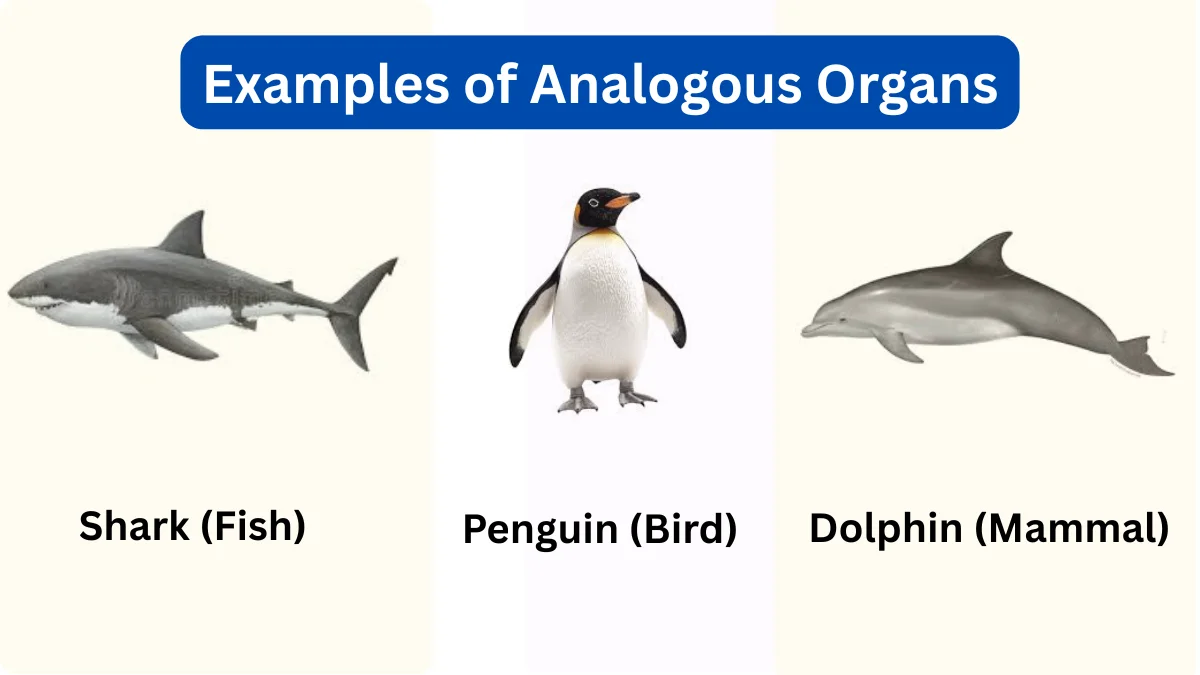
Common examples of analogous organs include wings of birds, butterflies, and bats; flippers of dolphins, penguins, and sharks; eyes of octopus and humans; storage organs like sweet potato and potato; climbing structures like pea and grapevine tendrils; protective spines of firethorn and barberry; and photosynthetic stems of opuntia.
What are Analogous Organs?
Analogous organs are body parts in different species that perform the same functions but have different structures. These analogous organs do not share common ancestory.
Analogous organs give us proof of convergent evolution. Convergent evolution happens when unrelated species develop similar traits. They face the same environmental challenges. So they find the same solutions independently.
For example, birds and insects both fly. But a bird wing has bones and feathers. An insect wing has no bones. It is just a thin layer of skin. The two wings look alike from outside. But inside, they are completely different. This shows they evolved on their own.
Examples of Analogous Organs
The following examples of analogous organs show how different animals and plants evolved to survive in their environments.
Examples of Analogous Organs in Animals
Here are some examples of analogous organs in animals:
1. Wings of Birds, Bats, and Insects
Wings of Birds, Bats, and Insects all are used for flying. But they have evolved in totally different ways. Bird wings have bones like our arms. Feathers cover them. Bats also have bones inside their wings. But their skin is stretched between long finger bones.
Insect wings have no bones at all. They are made of a thin, tough material called chitin. They are just extensions of the body wall. These three different animals, have three different wing structures and origin, but perform similar functions.
2. Flippers of Dolphins and Penguins
Dolphins live in water. Penguins also swim in water. Both have flippers that help them move in water. But dolphins are mammals. Their flippers have bones like a human hand inside. Penguins are birds. Their flippers are modified wings with bird bones inside. The outside looks similar. The inside is different. They evolved separately for swimming.
3. Fins of Dolphins and Sharks
Dolphins and sharks both live in the ocean. They both have a fin on their back and fins on their sides. But dolphins are mammals. Their fins have bones. Sharks are fish. Their fins are made of cartilage and have no bones. Fins of dolphins and sharks have different structures but have evolved to perform similar functions.
4. Eyes of Octopus and Human
Octopus eyes and human eyes look very similar from outside. Both have a lens, a retina, and a pupil. Both work like a camera. But they evolved completely separately. In humans, the nerves from the retina go to the brain through a hole in the retina. This creates a blind spot. In octopus, the nerves connect from behind. There is no blind spot. This represents a perfect example of convergent evolution.
5. Lungs of Humans and Gills of Fish
Lungs of humans and gills of fish Both help animals breathe. Both take oxygen from the environment. But human lungs are inside our chest. They pull air in and out. Fish gills are on the sides of their head. They take oxygen from water. The structure of lungs of humans and gills of fish is completely different, and the origin is different. But the function is the same: getting oxygen to survive.
Examples of Analogous Organs in Plants
Examples of analogous organs in plants include:
1. Potato and Sweet Potato
Potato and sweet potato both store food for the plant. Both grow underground. Both are eaten by humans. But a potato is a modified stem. It has eyes which are buds. A sweet potato is a modified root. It has no buds. It shows that potato and sweet potato have different structures and origin, but evolved to perform similar functions.
2. Tendrils of Pea and Grapevine
Tendrils of pea and grapevine both help plants climb. Both are thin and coil around things. But pea tendrils are modified leaves. Grapevine tendrils are modified stems. Same shape. Same job. Different starting point.
3. Spines of Firethorn and Barberry
Both these plants have sharp spines for protection. Firethorn thorns are modified stems. Barberry spines are modified leaves. Spines of firethorn and barberry having different structures, have evolved to do similar functions.
4. Leaves of Opuntia and Normal Leaves
Opuntia is a cactus. Its green, flat parts look like leaves. But they are actually stems. They do the function of leaves that is making food from sunlight. The real leaves of Opuntia are tiny and fall off quickly. The stem took over the leaf’s function. A normal plant uses leaves for photosynthesis. Opuntia uses stems. These are different structures, but evolved to perform same functions.
5. Roots of Carrot and Tuber of Potato
Roots of carrot and tuber of potato both store food. Both grow underground. But carrot is a modified root. Potato is a modified stem. They have different origin, but perform similar function of storing food.
Frequently Asked Questions
What is an example of analogous organs?
Bird wings and butterfly wings are a good example of analogous organs. Both are for flying. But bird wings have bones. Butterfly wings have no bones.
What is the difference between analogous and homologous organs?
Analogous organs have different structure but same function. Homologous organs have same structure but may have different function.
Do plants have analogous organs?
Yes. Potato and sweet potato are analogous structures. Both store food. Potato is a modified stem. Sweet potato is a modified root.
Why are human eyes and octopus eyes analogous?
Because human eyes and octopus eyes look alike and perform the same function. But they evolved separately. Their structure is slightly different inside. Octopus eyes have no blind spot, while human eyes have blind spot.
What is convergent evolution?
Convergent evolution occurs when unrelated species develop similar traits because they live in similar environments. Analogous organs show convergent evolution.
Are fish gills and human lungs analogous?
Yes. fish gills and human lungs both help breathing. But they are completely different in structure. Gills work in water. Lungs work in air.