
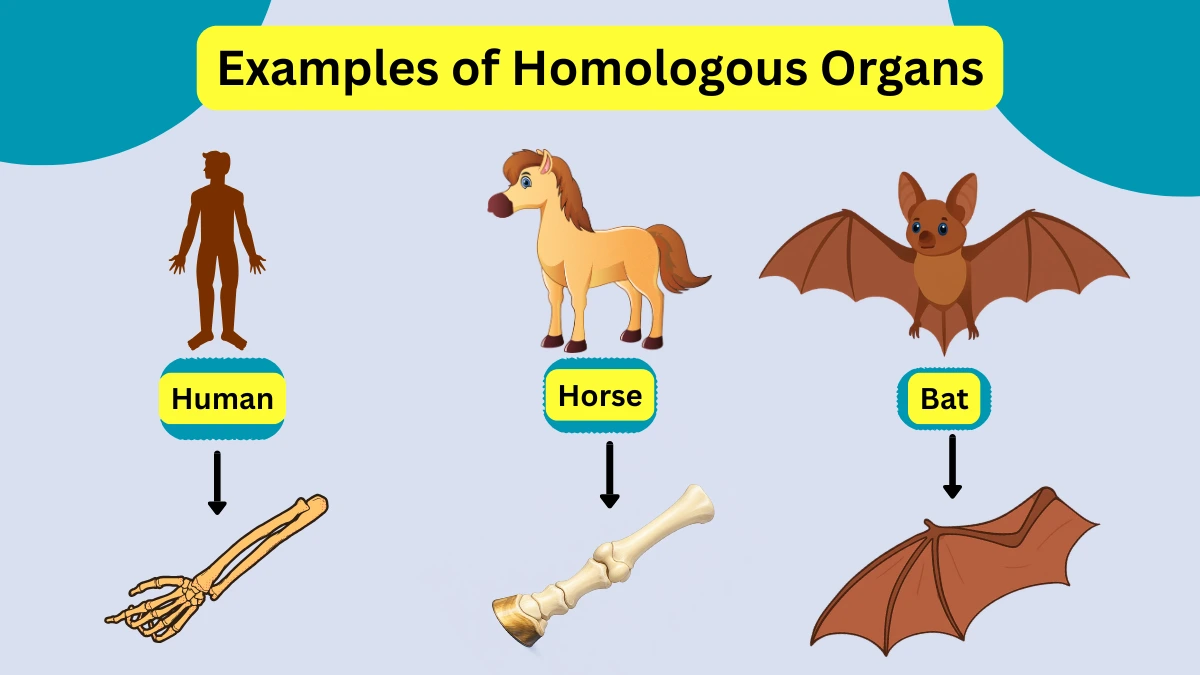
Examples of homologous organs include structures like human arms, whale flippers, bat wings, horse legs, bird wings, elephant tusks, human teeth, and honeybee stingers. Some common examples of homologous organs in plants include grapevine tendrils, bougainvillea thorns, pitcher leaves, Venus’s flytrap, cactus spines, onion scales, potato tubers, and ginger rhizomes.
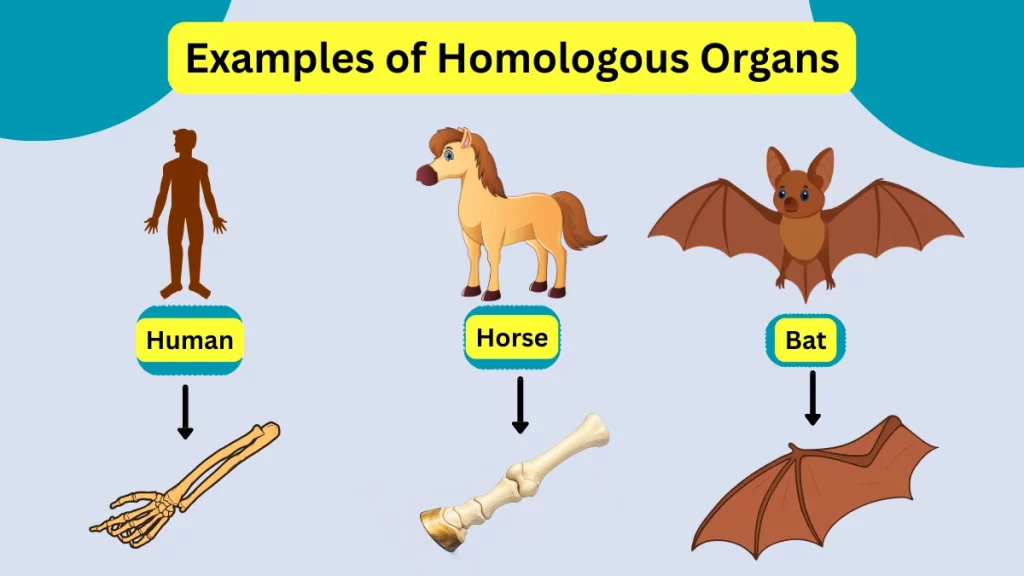
What are Homologous Organs?
Homologous organs are body parts in different animals that have the same basic structure, but they perform different functions. While analogous organs have different structures and different origin, but they perform the same functions.
Homologous organs share common ancestry.
For example, a human arm and a whale flipper contain the same bone structures. Humans use arms for lifting. Whales use flippers for swimming. This shows that both species share an ancient common ancestor. Over time, through the process of natural selection, their bodies have evolved to adapt to different environments, this phenomenon is known as divergent evolution.
Scientists use homologous organs to build family trees of life. Species that share more homologous parts are more closely related.
Examples of Homologous Organs
The following examples show that how the same basic structures have been evolved for different purposes across animals, humans, and plants.
Examples of Homologous Organs in Animals
Here are some examples of homologous organs in animals:
1. Vertebrate Forelimbs
All vertebrate forelimbs share the same bone structure. They have one upper arm bone, two lower arm bones, wrist bones, and finger bones. But they look different because animals use them for different functions:
- The human hand has five fingers for grasping.
- The whale flipper is flat and wide for swimming.
- The bat wing has long finger bones with skin stretched between them for flying.
- The horse leg has reduced toes and walks on one big toe with a hoof.
- The cat paw has soft pads and claws for walking and hunting.
- The bird wing has feathers and some fused bones for flight.
- The frog leg is short and strong for jumping.
- The mole paw is wide and spade-like for digging.
- The lizard leg has five toes with claws for climbing.
- The turtle flipper is flat like a paddle for swimming.
2. Vertebrate Hearts
Fish, frogs, lizards, birds, and mammals all have hearts, but their hearts have different numbers of chambers:
- Fish have two chambers.
- Frogs have three chambers.
- Most lizards have three chambers.
- Birds and mammals have four chambers.
The four-chamber heart is best at separating oxygen-rich blood from oxygen-poor blood. All these vertebrate hearts originated from a common ancestor in early animals.
3. Vertebrate Brains
All vertebrates have a brain with three main parts. The cerebrum handles thinking and learning. The cerebellum controls movement and balance. The medulla controls breathing and heartbeat.
- Fish have small brains.
- Mammals have larger brains.
- Humans have the biggest cerebrum compared to body size.
But the basic brain structure is the same for all these vertebrates.
4. Insect Mouthparts
Insects eat different foods, so their mouthparts are different, but they all have the same basic structure of mouthparts.
- Cockroaches have strong jaws for chewing solid food.
- Honey bees have jaws for chewing and a long tongue for sucking nectar.
- Butterflies have a long coiled tube for sucking nectar from flowers.
- Mosquitoes have a sharp needle for piercing skin and sucking blood.
5. Elephant Tusk and Human Teeth
Elephant tusks are really just very long teeth. They are made of the same material as human teeth. Both have hard enamel on the outside and softer dentin inside. Humans use their small incisors for biting food. Elephants use their long tusks for digging and fighting. But the basic tooth structure is the same.
6. Honeybee Stinger and Cricket Ovipositor
The stinger of a honeybee is a modified egg-laying tube. Female crickets have a long tube called an ovipositor for laying eggs in soil. Wasps also have ovipositors. In honeybees, this tube evolved into a stinger for defense. It connects to poison glands and can stab enemies. All these body parts have evolved from the same basic structure.
Examples of Homologous Organs in Humans
Here are some examples of homologous organs in humans:
1. Human Arm and Bat Wing
Human arms and bat wings have the same bones. Both have one upper arm bone, two lower arm bones, wrist bones, and finger bones. Human fingers are short and can grab things. Bat fingers are very long and hold up a thin skin for flying. The bones are the same, they are just shaped differently.
2. Human Arm and Whale Flipper
The same bones like human arm are inside a whale flipper. But they are short and flat. They form a paddle for swimming in whales. Human bones are longer and separate for grabbing. Scientists can match each human arm bone to a whale flipper bone.
3. Human Arm and Horse Leg
Horses run on one toe. Humans have five fingers. But inside a horse leg, you can find the same bones. The upper arm bone is there. The two lower arm bones are there, but they are fused together. The wrist bones are there. The finger bones are reduced to one big toe with a hoof. These same bones in both human and horse leg, have evolved for running in horse leg.
4. Human Tailbone and Monkey Tail
Humans have a small bone at the bottom of the spine called the tailbone. Monkeys have a long tail made of many small bones. These bones are the same. Humans lost their tail during evolution. But the tailbone remains. It now holds muscles in that place. It shows that we came from tailed ancestors.
Examples of Homologous Organs in Plants
Here are some examples of homologous organs in plants:
1. Grapevine Tendrils and Bougainvillea Thorns
Grapevine tendrils and bougainvillea thorns both emerge from the same nodal point on the stem. Grapevine tendrils are thin and curl around things. They help the plant climb. Bougainvillea thorns are sharp and pointy. They protect the plant from animals. They have same origin, but they perform different functions.
2. Pitcher Plant Leaves and Venus Flytrap Leaves
Pitcher plant leaves and venus flytrap leaves are leaves that catch insects. Pitcher plant leaves form a deep cup with liquid inside. Insects fall in and cannot get out. Venus flytrap leaves have two halves that get close when an insect touches them. Both grew as normal leaves that made food from sunlight. Now they have evolved to trap food instead.
3. Cactus Spines and Onion Scale Leaves
Cactus spines and onion scale leaves are modified leaves. Cactus spines are sharp and thin. They protect the cactus and save water. The green cactus stem does the food-making. Onion scale leaves are thick and fleshy. They store food and water underground. Both were once normal leaves that have evolved to perform different functions.
4. Potato Tuber and Ginger Rhizome
Potato tuber and ginger rhizome grow underground. But they are stems, not roots. Potato tubers are fat and store starch. The eyes on a potato are buds that can grow new plants. Ginger rhizomes grow sideways and from where new shoots arise. Both structures share a common origin.
5. Poinsettia Red Leaves and Cactus Spines
Both started as leaves. Poinsettia has bright red leaves called bracts. These bracts attract insects and birds to the flowers. Cactus spines protect the plant and stop water loss. One attracts, and one protects. Poinsettia red leaves and cactus spines have same origin (common ancient ancestors).
6. Sweet Pea Tendrils and Pea Plant Leaves
Sweet pea tendrils and pea plant leaves have same leaf origin, but they have evolved to perform different functions. Sweet pea tendrils are thin and coil around things. They help the plant climb. They are actually modified leaves. Normal pea plant leaves are flat and make food.
Frequently Asked Questions
What is an example of homologous organs?
Human arm and whale flipper is a good example of homologous organs. Both have the same bone structures, but they have evolved to perform different functions. Humans use arms for grabbing. Whales use flippers for swimming.
What is the difference between homologous and analogous structures?
Homologous structures are body parts in different species that share the same basic structure because they evolved from a common ancestor. They may perform different functions, for example, human arm for lifting and a bat wing for flying. Homologous structures exhibit divergent evolution. Analogous structures are body parts in different species that perform the same function but have different structure and evolutionary origins. Bird wings and butterfly wings both enable flight but evolved independently, through convergent evolution.
Do plants have homologous structures?
Yes. Grapevine tendrils and bougainvillea thorns are homologous structures. Both have the common stem origin but they have evolved to exhibit different functions.
Why is the human tailbone homologous to a monkey tail?
Because human tailbone and monkey tail both share similar bone structures. Humans lost their tail but have the tailbones that evolved to perform different functions in the modern humans. It proves we had tailed ancestors.
Are fish gills and human lungs homologous?
No, fish gills and human lungs are analogous. They have different structures but both help get oxygen.
What is divergent evolution?
Divergent evolution occurs when related species evolve over time. Homologous organs show divergent evolution.